The Hermès Birkin 25 Noir: Togo Leather with Matte Niloticus Crocodile Trim and Gold Hardware — A Complete Collector's Guide
- Get link
- X
- Other Apps
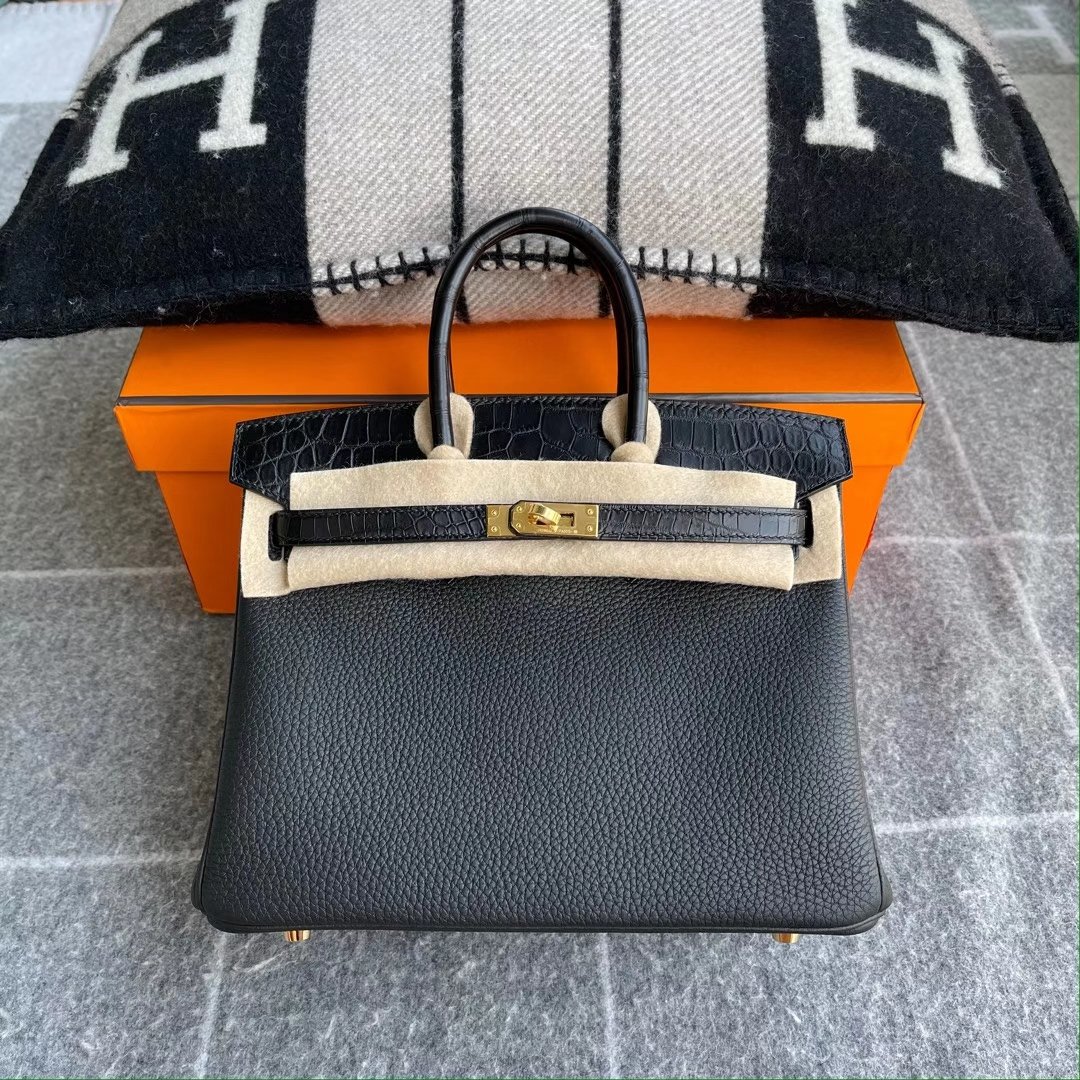
Few objects in the world of luxury carry the weight—both literal and cultural—of the Hermès Birkin. Among the myriad configurations produced by the maison's artisans in Pantin, one particular specification stands apart for its quiet complexity: the Birkin 25 in black Togo leather with matte Niloticus crocodile trim and gold hardware. This is a bag that combines the workhorse durability of Hermès's most beloved calfskin with the rarefied exclusivity of exotic skin, all wrapped in the house's most iconic colorway. What follows is a detailed examination of this configuration—its materials, construction, design logic, market position, and the practical considerations that matter to collectors and first-time buyers alike.
1. The Format: Why 25cm Matters
The Birkin 25 is the smallest standard Birkin size (alongside the rarely seen 20cm Faubourg and the sellier-structured 25). Introduced as part of Hermès's gradual expansion of the Birkin line, the 25cm has evolved from a niche "mini" into one of the most sought-after sizes in the entire catalog. Its dimensions—approximately 25cm wide, 20cm tall, and 13cm deep—make it a compact top-handle bag that reads as jewelry rather than luggage.
The 25cm appeals for several reasons:
Proportion and elegance. At this scale, the Birkin's architecture—the flap, the sangles (straps), the touret (turn-lock)—compresses into something almost architectural. The bag sits neatly in the crook of the arm or can be carried by hand.
Scarcity. Hermès produces fewer 25cm Birkins than 30cm or 35cm models, and boutiques rarely offer them to walk-in clients. The 25cm is typically reserved for established clients with meaningful purchase history.
Versatility. It transitions from day to evening more convincingly than larger Birkins, particularly in noir with gold hardware, which skews formal.
The trade-off is capacity: the 25cm holds a phone, cardholder, keys, lipstick, and sunglasses—but little more. It is not a work bag. It is a bag for someone who has other bags for work.
2. The Leather: Togo in Noir
Togo is Hermès's most recognizable and widely produced calfskin, introduced in the late 1990s and named—depending on which origin story you prefer—after the Togo region of West Africa or simply as a house designation. It is a pebbled, full-grain calfskin with a soft hand and a pronounced, irregular grain.
Characteristics of Togo:
Durability. Togo is among the most hard-wearing Hermès leathers. Its pebbled surface resists scratches, scuffs, and light rain remarkably well. A Togo bag can be used daily for years and develop a rich patina without showing the wear that would mar a smoother leather.
Structure. Togo is supple and slouchy. A Togo Birkin will not hold a rigid, architectural shape the way Epsom or Box calf will; over time it softens and relaxes, which many collectors consider a virtue.
Weight. Togo is lighter than Clemence (the other heavily pebbled house leather) and holds its shape better, making it the default choice for most Birkin buyers.
Grain variation. No two Togo hides are identical. The pebbling varies in size and density, and this natural irregularity is part of the leather's charm.
Noir is Hermès's black—a deep, saturated, true black that does not read as charcoal or blue-black. In Togo, noir has a slight matte-to-satin luster rather than high shine. Black Togo is prized for its ability to hide the natural slouch and wear that develops with use; it is arguably the most practical color in the Hermès palette.
3. The Exotic Trim: Matte Niloticus Crocodile
The defining feature of this configuration is its exotic trim. Hermès uses the term Niloticus to refer to the Nile crocodile (Crocodylus niloticus), one of the three crocodilian species the house works with (alongside Alligator Mississippiensis and Crocodylus Porosus). Niloticus is distinguished by its large, square-ish scales with visible "pores" (hair follicles) and a relatively flat, regular pattern across the hide.
Matte vs. Luster
Hermès finishes crocodile in two ways: matte and luster (sometimes called "shiny"). Matte Niloticus is treated to suppress reflection, producing a velvety, understated surface. Luster Niloticus is polished to a high gloss. Matte finishes are generally considered rarer and more refined; they are also more demanding in terms of care, as matte exotic skins can absorb moisture and oils more readily than glazed finishes.
Where the trim appears
In a "trim" configuration—sometimes described as a bi-material or combined leather bag—the exotic skin is used selectively rather than across the entire body. Typical placements include:
The sangles (the two front straps that secure the flap)
The touret and its surrounding hardware plate
The handle attachments and sometimes the handle itself
The top flap edge or piping
Occasionally the side gussets or base
The result is a bag that reads as predominantly Togo from a distance but reveals its exotic character on closer inspection—a detail-oriented, connoisseurial aesthetic. Hermès has produced such combinations in various forms over the decades, and they command a premium over all-calfskin equivalents while remaining less expensive than fully exotic bags.
Why Niloticus?
Niloticus crocodile is more durable and less prone to scale-lifting than Porosus, and its larger scales suit the small surface areas of trim work. Matte Niloticus in black is among the most restrained exotic treatments Hermès offers—no color variation, no gloss, just texture and depth.
4. Hardware: Gold
Hermès offers hardware in gold-plated brass (often called "gold" or "GHW"), palladium (PHW), and occasionally brushed or exotic finishes. Gold hardware on a black bag is the classic, most traditional combination—and in recent years, among the most requested.
Considerations for gold hardware:
Warmth. Gold warms the starkness of noir, giving the bag a richer, more vintage-inflected character than palladium's cool silver tone.
Durability. Gold-plated hardware can show fine scratches and, over many years, slight fading or "rubbing" at high-contact points (the touret, the feet). This is normal and generally accepted; Hermès will not replate hardware as a standard service, though spa treatments can address some issues.
Market preference. In the resale market, gold hardware on black Birkins typically commands a modest premium over palladium, particularly in Asia and the Middle East. The combination of noir + GHW is often described as the "forever" configuration.
The hardware suite on a Birkin 25 includes the touret (turn-lock), four base feet, the handle rings, the sangles' plates, and the internal zip pull. All are finished in matching gold.
5. Construction and Craftsmanship
Each Birkin is made by a single artisan who signs off on the bag, and the 25cm takes roughly 18–20 hours of labor. Key construction details:
Saddle stitching. The bag is assembled using two-needle saddle stitching, a technique that creates a stronger, more durable seam than machine stitching and is a hallmark of Hermès production.
Edge finishing. Edges are painted and burnished in multiple layers, a process that takes days to complete and cure.
The flap and sangles. The sangles are functional—they thread through the touret plate and secure the flap—but most owners leave them closed and use the turn-lock alone for access.
Interior. The Birkin 25 interior is lined in matching leather (typically Chevre Mysore or a comparable lining) with one zip pocket and one slip pocket.
Bi-material assembly. Combining Togo and Niloticus requires the artisan to match thicknesses and finishes at the seams—a more demanding build than a single-leather bag, and one reason bi-material Birkins are produced in smaller numbers.
6. The Aesthetic: Reading the Bag
The noir Togo / matte Niloticus / gold configuration is, aesthetically, a study in restraint. From arm's length it is a black Birkin—arguably the most recognizable luxury object in the world. Up close, the matte crocodile trim introduces a tactile and visual counterpoint: the pebbled calfskin's softness against the crocodile's structured scales, the matte finish's light absorption against the gold hardware's warmth.
It is a bag that rewards the owner rather than the observer—the exotic detail is for the person carrying it, not for the room. This is consistent with a broader shift in Hermès clientele toward understated, material-focused specifications over logo-forward or color-blocked designs.
7. Market Position and Pricing
Retail pricing for a Birkin 25 varies by market and year; as a reference point, a standard Togo Birkin 25 retailed in the range of roughly $10,000–$12,000 USD in recent years, with exotic-trim and fully exotic versions priced substantially higher. A bi-material Togo/Niloticus bag sits between the all-calfskin and all-exotic tiers—expect a meaningful premium over standard Togo, though exact figures depend on the boutique, region, and year.
Resale dynamics: The Birkin 25 is among the strongest performers in the secondary market. Black with gold hardware is the most liquid configuration. Bi-material bags are rarer and appeal to a narrower but enthusiastic buyer pool; they can trade at a premium to equivalent all-Togo bags, though the premium is less predictable than for, say, a full Niloticus Birkin. Authentication is essential: the exotic trim adds complexity that counterfeiters often get wrong (scale pattern, pore distribution, matte finish consistency).
Acquisition reality: Hermès does not sell Birkins online or to walk-in clients. The bag is offered—"quota bags," in collector parlance—to clients with established purchase history. A bi-material 25cm is a rare offer; clients seeking one should expect to wait and to build a relationship with a boutique.
8. Care and Ownership
Matte Niloticus care. Keep the exotic trim away from water, hand creams, and prolonged sunlight. Matte finishes can darken or spot with moisture. Store the bag in its dust bag, stuffed to maintain shape, in a cool, dry place.
Togo care. Togo is forgiving; a soft, dry cloth is sufficient for routine cleaning. Avoid silicone-based conditioners.
Hardware. Wipe with a dry microfiber cloth. Accept that fine scratches will appear with use.
Spa services. Hermès offers restoration and repair through its spa; exotic skins are handled by specialized artisans, and turnaround can take months.
Insurance. Given replacement cost and market value, specialist collectors' insurance is advisable.
9. For the Collector: What to Look For
When evaluating a Togo/Niloticus bi-material Birkin 25:
Trim consistency. The crocodile scales should be uniform in finish (all matte), with no lifting or curling at edges.
Seam transitions. Where Togo meets Niloticus, stitching should be even and the leather thicknesses matched—no puckering.
Hardware plating. Check for fading at the touret and feet; light wear is normal, heavy wear affects value.
Date stamp and blind stamp. Located inside the bag; confirms production year and artisan.
Shape retention. A 25cm should hold its structure; excessive slouch may indicate heavy use or poor storage.
Documentation. Box, dust bag, rain cover, clochette (the leather-covered key bell), keys, and lock add value and aid authentication.Service Inquiries
10. Conclusion
The Birkin 25 in black Togo with matte Niloticus crocodile trim and gold hardware occupies a specific and rarefied place in the Hermès universe: it is a small-format, bi-material, classic-colorway bag that combines practicality (Togo's durability) with connoisseurial detail (matte exotic trim) and timeless hardware. It is not the flashiest Birkin, nor the rarest, but it may be one of the most intelligently specified—a bag designed for someone who knows the house deeply and prefers their luxury legible only up close.
For the collector, it represents a defensible acquisition: liquid colorway, coveted size, and a material combination that stands apart from the standard Togo flood. For the first-time buyer fortunate enough to be offered one, it is a bag that will age gracefully, wear honestly, and never look out of place—which is, in the end, the quietest form of luxury.
- Get link
- X
- Other Apps


Comments
Post a Comment