The Top-Handle Bag 25cm in Shiny Niloticus Crocodile, Braise, with Gold Hardware: A Complete Collector's Guide
- Get link
- X
- Other Apps
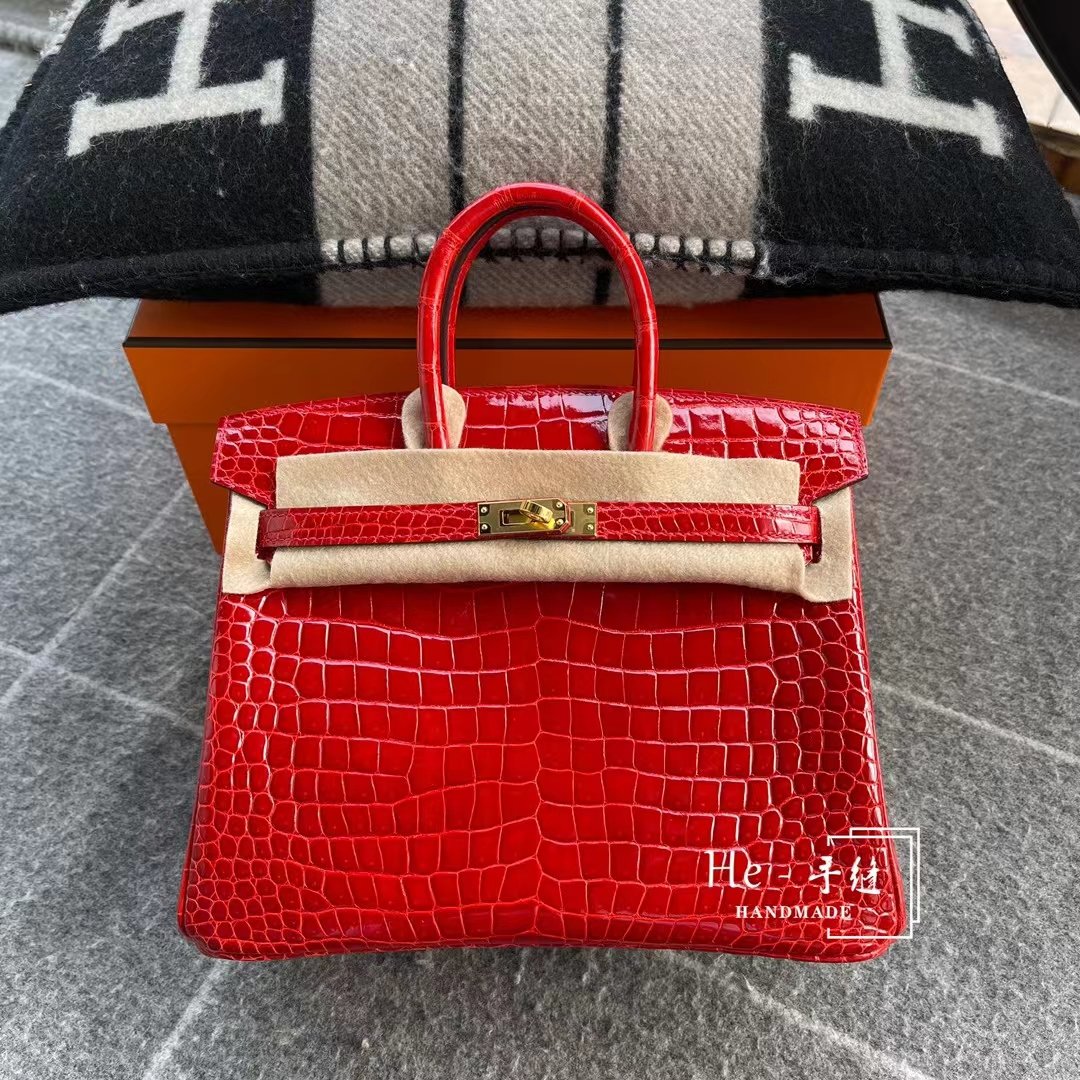
The 25cm top-handle bag — the Hermès Birkin 25 — is the most coveted size in the modern market, and when executed in shiny Niloticus crocodile with Braise (a fiery, burnished red-orange) and gold hardware, it becomes one of the most dramatic and collectible configurations in the entire lineup. This article covers the silhouette, the exotic leather, the color, the hardware, craftsmanship, market dynamics, and ownership considerations in detail.
1. The Silhouette: Why 25cm?
At approximately 25cm wide, 18cm high, and 13cm deep, the Birkin 25 is the smallest classic Birkin (the 20cm "HAC" and micro variants aside). It has overtaken the 30cm as the most in-demand size for several reasons:
Proportion and presence: The compact body makes the bag read as jewelry-like — a statement accessory rather than a utility tote.
Carry options: Hand-carry or forearm-carry; the 25cm does not fit over the shoulder.
Exotic suitability: Small panels show off crocodile scales to maximum effect, and the 25cm is a favored canvas for exotic skins precisely because fewer, larger, more perfect scales are required per panel.
Scarcity: The 25cm is produced in far smaller numbers than the 30cm and is disproportionately allocated to VIP clients, making it the hardest classic size to obtain at retail.
Structural features: rolled handles with saddle stitching, twin sangle straps with a central turn-lock, clochette with two keys, padlock, interior zip and slip pockets, chevre lining, and four protective base feet — all standard Birkin architecture, scaled down.
2. The Leather: Shiny Niloticus Crocodile
Niloticus refers to Nile crocodile (Crocodylus niloticus), one of Hermès' principal exotic skins alongside Alligator Mississippiensis and Porosus crocodile. "Shiny" denotes the finish: a highly polished, mirror-like surface achieved through extended hand-buffing and glazing.
Characteristics of shiny Niloticus:
Scale pattern: Nile crocodile typically shows a distinctive pattern of larger, rectangular scales across the center of the body, flanked by smaller, rounder scales toward the edges — a "tile" effect that is instantly recognizable and prized by collectors.
Shine: The glossy finish amplifies color saturation dramatically; Braise in shiny Niloticus reads almost luminous, with deep highlights and near-black shadows in the scale crevices.
Hand: Firm and structured relative to Togo or Clemence — exotic Birkins hold their shape beautifully and resist slouching.
Rarity within exotics: Shiny Niloticus is produced in smaller quantities than matte Alligator; shiny finishes require flawless skins, as polishing exposes any defect.
Care — critical for exotics:
Water is the enemy. Shiny crocodile is not waterproof; water spotting and blistering are largely irreversible. Avoid rain entirely, and never store in humid environments.
No conditioning creams unless specifically formulated for exotic skins; oils can cloud the glaze.
Handle with dry, clean hands — oils and sweat dull the shine and darken handles over time.
Store flat or lightly stuffed, upright, in the dust bag, away from sunlight (which fades reds particularly fast) and heat (which can dry and crack scales).
Long-term: Exotic skins can dry over decades; professional exotic-skin care from a specialist (not a general cobbler) is advisable every several years.
3. The Color: Braise
Braise (French for "ember" or "burning coals") is a rich, saturated red-orange — a burnished brick-red with warm undertones that shifts between true red and a glowing coral-orange depending on light. It is one of Hermès' most dramatic warm hues.
Why Braise is special:
Depth on shiny croc: The glossy finish turns Braise into something resembling molten lacquer — the color appears to glow from within, with darker tones in the scale valleys creating extraordinary dimensionality.
Rarity: Braise was produced in limited windows and is no longer a current standard offering; it appears primarily in exotic skins and select leathers from specific years, making it a grail color on the secondary market.
Warmth and versatility: Despite its boldness, Braise functions as a "warm neutral-plus" — it pairs strikingly with black, navy, cream, camel, and denim, and reads festive without being literal.
Gold hardware synergy: This is the key pairing. Braise's warm red-orange undertones are flattered maximally by gold hardware, which amplifies the ember quality and gives the bag a rich, heirloom-like warmth. Palladium would cool the color toward tomato-red; gold keeps it glowing.
Color-family comparisons: Rouge Casaque (true bright red), Rouge H (deep burgundy-red), Feu (orange-red, brighter), Vermillon (scarlet), Capucine (orange-red, softer). Braise sits between Feu and Rouge Casaque — warmer and more burnished than either.
4. The Hardware: Gold
Hermès gold-tone hardware is gold-plated brass, warm in tone and classic in character.
Aesthetic effect: Gold hardware on Braise shiny Niloticus creates a fully warm palette — ember red, honeyed metal — that photographs spectacularly and feels luxurious and traditional.
Wear characteristics: Gold plating can dull or, over many years of heavy use, show slight fading at high-friction points (turn-lock, handle rings). It can be gently polished; deep scratches on plated hardware are difficult to remedy without replacement.
Collector preference: For warm colors — Braise, Gold, Rouge H, Capucine — gold hardware is generally considered the "correct" pairing and commands a premium over palladium in resale for these combinations. The reverse is true for cool colors.
The full hardware set — turn-lock, sangle plates and pins, padlock, clochette hardware, handle rings, and feet — is matching gold.
5. Construction and Craftsmanship
Single-artisan construction: one craftsperson completes each bag, with saddle-stitched handles and sangles done entirely by hand.
Exotic skin matching: artisans match scales across panels — flap, body, gussets — so the pattern flows coherently; on a 25cm, scale matching is especially visible and is a key quality marker.
Edge finishing: painted edges, built up in multiple thin coats, are particularly delicate on shiny exotics.
CITES documentation: All Hermès crocodile bags ship with CITES permits (Convention on International Trade in Endangered Species). These papers are essential for legal resale and international travel; a bag without CITES documentation is significantly devalued and may be non-transferable across borders.
6. Market Context and Valuation
This is a top-tier secondary market configuration: 25cm (most demanded size) + shiny Niloticus (premium exotic) + Braise (rare, discontinued warm color) + gold hardware (optimal pairing).
Retail: Exotic Birkins are priced far above leather equivalents — a 25cm Niloticus Birkin at retail sits well into five figures (roughly $30,000+ depending on year and region), and availability at retail is essentially invitation-only.
Secondary market: Braise shiny Niloticus 25cm bags trade at substantial premiums — often $45,000–70,000+ depending on year, condition, and completeness, with pristine full-set examples at the higher end. Condition is paramount: scale lifting, dryness, water damage, or handle darkening each take meaningful bites out of value.
Full set: box, two dust bags, rain cover, clochette, lock and keys, CITES papers, and receipt. CITES is non-negotiable for serious buyers.
Authentication: exotic skins are counterfeited extensively. Verify scale pattern authenticity (real croc scales are irregular, with visible follicles and pore structure), stitching, hardware engraving, date-code format, and CITES documentation. Specialist authentication is essential.
7. Styling and Ownership
Styling: The Braise 25cm is a color statement — let it lead. Pair with black tailoring, cream knitwear, navy suiting, or denim-and-blazer combinations; avoid competing reds. It suits evening as readily as day, which is part of the 25cm's appeal.
Ownership realities:
Weather discipline: this is not a rainy-day bag. Keep a protective pouch for travel and avoid humid climates for storage.
Rotation: exotics benefit from periodic wear (natural skin oils in moderation) but should not be over-handled; store away from light.
Insurance: appraise and insure explicitly as an exotic — standard policies may exclude or under-cover CITES-restricted items.
Travel: carry CITES documentation when crossing borders; some countries require import/export permits even for personal ownership.
- Contact Us Page
8. Summary Verdict
The 25cm top-handle bag in shiny Niloticus crocodile, Braise, with gold hardware is a collector's piece in the truest sense: the most desirable size, a premium exotic skin with dramatic scale pattern and mirror finish, a rare and no-longer-produced ember-red color, and the hardware pairing that maximizes its warmth. It is not an everyday bag in the way a Togo 30cm is — it demands weather awareness, careful storage, and CITES paperwork — but as a jewel-like statement piece with strong secondary-market fundamentals, it sits at the very top of the desirability hierarchy.
- Get link
- X
- Other Apps


Comments
Post a Comment